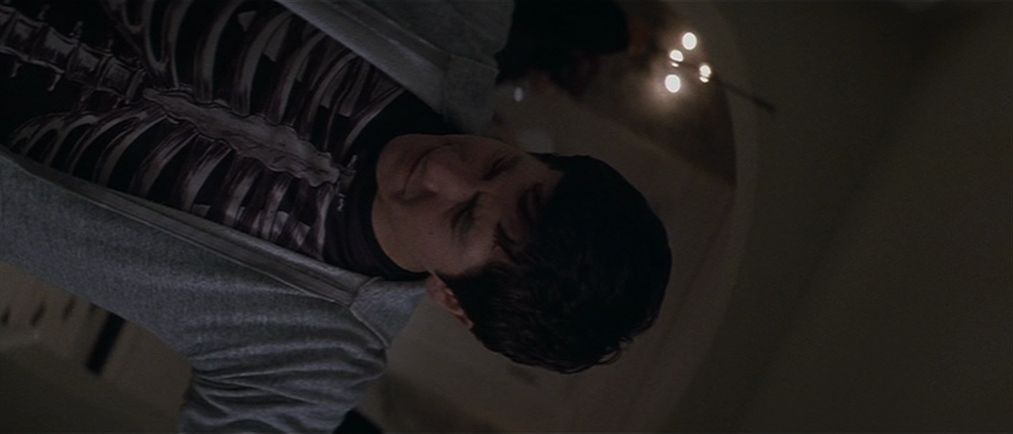
Directed by Richard Kelly
9/10
4/10
3.5/10
9.5/10
10/10
10/10
The Rabbit Hole of Suburban Apocalypse: Horror as Existential Crisis
Richard Kelly's Donnie Darko occupies a unique space in the horror landscape—a film that doesn't announce its genre credentials with traditional scares but instead creates a sustained atmosphere of cosmic dread so pervasive that it transforms adolescent angst into genuine existential terror. This is horror as philosophical crisis, a work that uses science fiction elements and suburban Gothic atmosphere to explore the fundamental question of whether individual existence matters in an indifferent universe. Twenty-three years after its release, it remains one of cinema's most engaging and haunting meditations on fate, free will, and the terrible weight of understanding too much too young.
Kelly's achievement lies in his ability to weave together multiple genre elements—teen drama, science fiction, psychological thriller, suburban satire—into something that feels both deeply familiar and utterly unprecedented. The film operates simultaneously as a coming-of-age story, a time travel narrative, and a portrait of American suburban decay, but its deepest horror emerges from the gradual revelation that Donnie's growing awareness of cosmic forces makes him increasingly isolated from everyone he loves.
Jake Gyllenhaal delivers a career-defining performance as Donnie, creating a character who feels authentically adolescent while carrying the weight of someone forced to confront metaphysical realities far beyond his years. Gyllenhaal captures both Donnie's intelligence and his fundamental vulnerability, his sarcastic wit serving as armor against a world that seems designed to crush sensitive souls. Watch how he physically embodies the character's journey from troubled teenager to reluctant cosmic agent—his posture gradually straightening as he accepts his role, his eyes growing more distant as he sees patterns others cannot perceive.
The supporting performances create a vivid ecosystem of suburban dysfunction and authentic human connection. Jena Malone as Gretchen provides the film's emotional center, her relationship with Donnie serving as the crucial human anchor that makes his ultimate sacrifice feel genuinely tragic. Mary McDonnell and Holmes Osborne as Donnie's parents create a portrait of adults struggling to understand their troubled son while dealing with their own limitations and fears.
Drew Barrymore, Patrick Swayze, and Noah Wyle as the various adult authority figures represent different forms of institutional failure, each character revealing how society's supposed protectors are often as lost and confused as the children they're meant to guide. Swayze's Jim Cunningham, in particular, becomes a perfect representation of the film's central theme—the way charismatic authority figures can mask profound moral corruption.
The film's visual language creates a world that feels both recognizably suburban and subtly apocalyptic. Kelly and cinematographer Steven Poster capture the peculiar melancholy of late-twentieth-century American suburbia, where prosperity and safety coexist with an underlying sense of spiritual emptiness. The autumn setting, with its dying leaves and shortened days, provides the perfect backdrop for a story about endings and transformations.
The famous liquid spear sequences, showing the paths of future actions, represent one of cinema's most effective visualizations of predetermined fate. These moments don't feel like special effects spectacle but like glimpses into a cosmic order that operates beyond human understanding, making visible the invisible forces that shape our choices.
Michael Andrews' score, featuring Gary Jules' haunting cover of "Mad World," deserves recognition as one of horror's most emotionally devastating musical achievements. The music doesn't simply accompany the action—it becomes the film's emotional voice, expressing the melancholy and wonder that words cannot capture. The soundtrack's blend of 1980s nostalgia and contemporary indie sensibilities creates a temporal displacement that mirrors the film's themes about time and memory.
The film's production design creates a world that exists in a specific time and place—late 1988 in suburban Virginia—while feeling timeless in its exploration of universal themes. The period details never feel like nostalgic window dressing but serve the story's deeper concerns about cycles of history and the persistence of human nature across generations.
Donnie Darko's treatment of mental illness demonstrates remarkable sophistication, presenting Donnie's psychological struggles as genuine medical concerns while never dismissing the possibility that his visions might represent actual supernatural contact. The film suggests that the line between madness and enlightenment may be thinner than society pretends, that those who see too clearly are often dismissed as disturbed rather than gifted.
The film's exploration of religious and philosophical themes creates one of cinema's most complex treatments of faith and determinism. Frank the Rabbit becomes a figure that operates simultaneously as psychological projection, supernatural entity, and symbolic representation of fate itself. The film's cosmology, involving tangent universes and time loops, provides a framework for exploring free will versus determinism without offering easy answers.
Kelly's direction maintains perfect balance between the film's various tonal elements, never allowing any single aspect to dominate the others. The film feels simultaneously like a realistic teen drama and a cosmic horror story, a suburban comedy and an apocalyptic thriller. This tonal complexity makes the film endlessly rewatchable, with new interpretations and connections emerging with each viewing.
The school setting provides the perfect microcosm for exploring larger themes about conformity, authority, and the ways institutions shape individual identity. The various teachers and administrators represent different approaches to education and social control, while the students embody different responses to the pressures of adolescence and social expectation.
The film's famous ending, with Donnie's choice to accept his fate and return to his room to die, represents one of cinema's most genuinely moving acts of sacrifice. The conclusion works because it emerges naturally from everything the film has established about Donnie's character and his growing understanding of his role in larger cosmic patterns.
Donnie Darko's themes of alienation, social hypocrisy, and the search for meaning feel more relevant than ever in contemporary society. Kelly created a work that speaks directly to anyone who has felt like an outsider, anyone who has questioned the assumptions that others take for granted, anyone who has wondered whether individual actions matter in an apparently indifferent universe.
The film's influence on subsequent cinema cannot be overstated—it helped establish the template for intelligent genre filmmaking that trusts audiences to engage with complex themes and ambiguous conclusions. Its success proved that horror could be philosophical, that science fiction could be deeply emotional, that teen movies could tackle genuinely profound subjects.
The technical execution serves the film's vision perfectly, with every element—cinematography, sound design, editing, production design—contributing to the overall sense of cosmic unease and emotional authenticity. The result is a work that feels completely unified despite its genre-blending approach.
Donnie Darko stands as one of the most engaging and emotionally resonant films ever made, a work that uses horror elements to explore fundamental questions about existence, purpose, and human connection. It's a film that doesn't simply entertain—it haunts, challenges, and ultimately transforms those willing to follow it into its rabbit hole of suburban apocalypse. In a cinematic landscape often content with surface-level thrills, Kelly created something genuinely profound, a work that honors both the intelligence of its audience and the deep mysteries that make life both beautiful and terrifying.