Directed by Ari Aster
10/10
7/10
9/10
10/10
10/10
10/10
When Grief Becomes Grotesque: A Family Destroyed from Within
Ari Aster understands something most horror filmmakers do not. The scariest room in the world is a dining room. The scariest face is a mother's face. Hereditary begins as a grief film and becomes something else entirely, but the transformation is so gradual, so committed to its own internal logic, that by the time the ground falls away you have nowhere to go. You are already inside, and you have been inside since the first frame, since the camera moved through the window of Annie Graham's studio and into the miniature of the Graham house and the miniature became the actual house, since Aster told you in the first thirty seconds that everything in this film is a diorama and someone else is arranging the pieces.
The Graham family's destruction feels both supernaturally ordained and psychologically inevitable, and Aster never forces you to choose between those two readings. He holds them together the way grief holds love and rage together, without resolution, without relief. This is the film's central act of sophistication. Most horror films that flirt with psychological ambiguity eventually tip their hand, eventually let you know which reality is the true one. Hereditary refuses. Every supernatural event has a psychological shadow. Every psychological break has a supernatural echo. By the end you are not certain the distinction matters, and that uncertainty is more frightening than any answer the film could have provided, because the answer would mean you could put it somewhere, could file it under a category that the mind has a folder for, and the film has been methodically destroying every folder you reach for since the opening frame.
Toni Collette and the Grief That Does Not Know Its Own Name
Toni Collette does something here that is almost impossible to describe without sounding like you are overselling it, so consider this the one moment in this review where the subject demands something close to surrender: watch her hands at the funeral. Watch how she holds herself together like someone pressing both palms against a cracked wall. The explosion comes later. What breaks you is the stillness. What Collette understands about Annie Graham is that grief of this specific variety, the grief of someone who never loved cleanly, who is mourning a mother she also feared and resented and needed and could not escape and cannot now mourn without the resentment contaminating the mourning in ways she cannot account for and cannot stop, does not arrive as sadness. It arrives as confusion. As a kind of bodily disorientation. A state of not knowing how to hold the face because the face does not know what it is expressing, because what is being felt is not a feeling the body has a posture for.
Collette plays that not-knowing with a precision and a commitment that makes watching her feel transgressive. You feel like you are seeing something you were not supposed to see. She is not performing grief. She is performing the specific experience of a person who does not know how to perform this grief, who has not found the correct register for it, whose responses keep arriving slightly wrong in the way that all of Annie Graham's responses to her own life arrive slightly wrong. The emotional precision is always there beneath the surface. The surface keeps not quite cooperating. Later, when the grief curdles into something more extreme, when Annie is on the ceiling and in the attic and flinging herself against the walls of her own home, you believe it completely because Collette has already shown you a woman whose grip on the ordinary was always provisional, for whom the ordinary was a performance of normalcy that required sustained effort and was always close to the edge of something she could not name. The supernatural does not transform Annie Graham. It finishes what was already in motion, and Collette has been showing you the motion from the first scene so that when it finishes you recognize the completion rather than being surprised by it.
The grief support group scene is the film's most quietly devastating passage and the most completely realized piece of acting Collette has ever done, which is a statement that requires the full weight of her career to give it its proper scale. She describes her intrusive thoughts in the register of confession, of something that has been held inside for so long that the holding has become physical, and then at the end of the confession she laughs, and the laugh is the most complex single sound in the film, containing the horror of what she has just said and the relief of having said it and the awareness that the relief is temporary and the horror is permanent, all of it arriving simultaneously in a single sound that Collette produces with the ease of someone who has found the exact frequency the moment requires and simply opens to it.
The Cast in Annie's Orbit
Alex Wolff as Peter carries guilt the way teenagers actually carry it, badly and visibly, with no idea where to put it and no capacity to put it anywhere that would make it smaller. His performance in the car immediately after Charlie's death is one of the bravest pieces of acting in recent memory because it is not a performance in any conventional sense. He does nothing. He drives. His face does the thing that faces do when the mind has gone somewhere else to wait out the unsurvivable moment, when the processing has stopped because the event exceeds what processing can manage and the only available response is blankness, the specific blankness of a person who is present in their body and absent from their experience simultaneously. Aster holds on him for an unbearable duration. Wolff does not flinch, does not reach for expression, does not offer the audience the release of a reaction that would tell them how to feel. The blankness is the performance. The restraint is the performance. The willingness to do nothing when doing nothing is the most honest response to the situation is the performance, and it is harder than anything else Wolff does in the film.
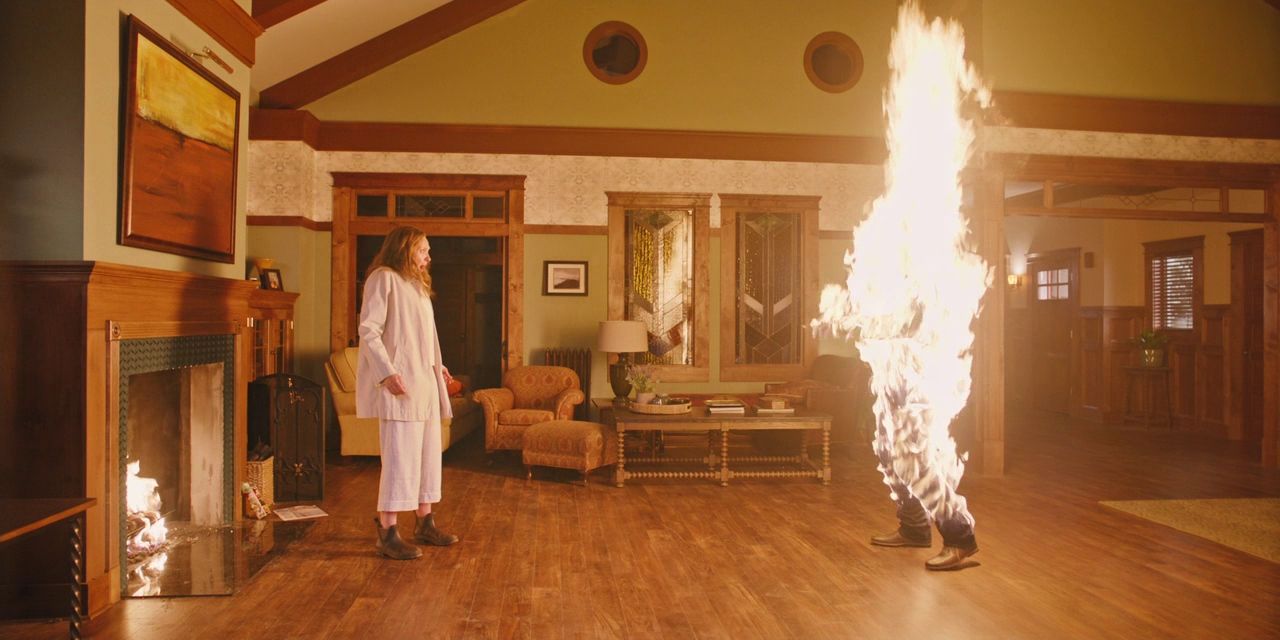
Gabriel Byrne as Steve is doing something equally difficult and less visible, the performance of a man who has decided that rational pressure applied consistently to an irrational situation will eventually produce a rational outcome, who keeps trying to insert the frame of comprehensible cause and effect around events that have no interest in being comprehensible, whose faith in the ordinary logic of the world is the thing he has to offer the people he loves and the thing that makes him useless in the situation the film has placed him in. Byrne plays this faith with a quiet sincerity that makes its eventual breaking as devastating as anything the film does with more explicit horror. Steve does not have a supernatural death. He burns. The fire is applied to him by something that does not have the time or the interest to do anything more sophisticated, and the casualness of the destruction is the point, the specific horror of the ordinary being eliminated by the supernatural as a practical matter, without ceremony, because it is in the way.
Milly Shapiro as Charlie is not creepy in any way that can be easily named, and the difficulty of naming it is itself the source of the effect. She is simply somewhere else. Looking at something just past the edge of the frame, directing attention toward something the camera cannot locate and the other characters cannot locate and the audience cannot locate, and the inability to locate it is the wrongness. There is a quality to her stillness that suggests she is not fully inhabiting the present tense, that some part of her attention is always directed toward something adjacent to the scene rather than inside it. This is more unsettling than anything a makeup department could manufacture because it does not read as performance. It reads as condition. She is a child who has always been directed toward something outside the frame and has never been anywhere else and does not know that this is not how everyone experiences the world.
When Charlie dies, the film does something almost cruel, which is to do it suddenly and finally and graphically in a way that the mind rejects even as the eyes confirm it, and then to refuse the cut that would release the tension, to put you in the car with Peter as the night passes and the morning comes and time moves through him like water through a body that has stopped being able to process it. Aster does not soften the approach. He does not offer the mercy of a cut to morning. He shows you time passing and the horror of time passing when something irreversible has occurred and the person inside the irreversibility cannot be anywhere else and cannot be in it and cannot find the place that is neither.
Pawel Pogorzelski's Camera and the House That Observes
Pawel Pogorzelski's cinematography frames the Graham family the way Annie frames her miniatures. Small. Observed. Already past tense. The camera has a habit of beginning scenes at a remove, pulling back to reveal characters in the corners and margins of their own home, dwarfed by walls and ceilings that feel slightly too large, slightly too present, as though the house has expanded slightly beyond its actual dimensions to accommodate something the family does not know is in it. It is a house that notices you back. The negative space in every composition is not decorative. It is argumentative. It is the film insisting that something else is always in the room, that the family is never alone in the space they occupy, that the air around them has weight and intention and has had weight and intention for much longer than the Graham family has been in the house.
There is a recurring compositional choice where a character is positioned far to one side of the frame and the rest of the image is held, dark and attentive and enormous, and it produces a specific kind of dread that is almost impossible to shake because it does not feel like a camera choice. It feels like a room. It mimics something everyone has felt, the specific quality of a space being wrong, of empty air insisting on itself, of the sensation that what is not visible is present with as much force as what is. Pogorzelski and Aster use this compositional grammar so consistently that by the midpoint of the film your nervous system has been trained to scan the dark portions of every frame for what is hiding in them, and the training is its own form of dread, separate from any specific frightening image, the condition of watchfulness that the film has manufactured in your body and that does not stop when the credits roll.
The opening shot deserves sustained attention because it is the film's complete argument delivered before a single line of dialogue. The camera moves through the studio window and into the miniature house and then the miniature house becomes the actual house with a cut so precise and so committed that the transition is not a trick but a statement of the film's governing metaphor, that everything in the Graham family's life is a miniature that someone else has built and is arranging, that their experience of agency and choice and the ordinary conduct of their lives is the experience of figures in a diorama who do not know they are figures in a diorama. Annie builds miniatures of traumatic events to make them small enough to contain. What she does not know, for most of the film, is that she is herself a miniature, that the traumatic event she is inside is being built at a scale she cannot perceive because she is inside it.
Colin Stetson and the Score That Knows
Colin Stetson's score does not underscore the dread. It is the dread. It arrives before the images do and lingers after they have gone, working in textures that feel simultaneously ancient and brutally contemporary, acoustic instruments processed and layered until they produce sounds that have no instrument equivalent, sounds that seem to be generated by something that should not be capable of generating sound. There are passages in the score that register more as physical sensation than musical experience, felt in the sternum and the back of the throat and the specific cavity behind the eyes where tension accumulates when the body is reading an environment as threatening. Stetson is scoring not the images but the information beneath the images, the layer of the film that exists below what is visible, the patient arrangement of pieces that has been happening in the Graham house since long before Annie moved her family into it.
The score knows things the characters do not yet know and it has no mercy about that knowledge. It tells you early. It tells you in the first scenes, before anything explicitly frightening has occurred, before any supernatural event has presented itself, telling you in the register of physical sensation rather than narrative information that the situation is already decided, that the family is already inside the mechanism, that what will happen has in some sense already happened and the film is the process of making it visible. This is the cruelest thing Stetson's score does, and it does it continuously. The music is always ahead of the characters, always in possession of the ending, playing you the conclusion while the family is still in the middle of their story and still believing that the story is theirs.
The Miniatures and What They Are Actually Doing
Annie's miniature dioramas are not simply a character detail or a clever visual motif. They are the film's argument in miniature, the thesis delivered as set dressing, hiding in plain sight the way the film's central revelation hides in plain sight from the first frame. Annie is an artist who recreates traumatic moments at reduced scale, who takes the unsurvivable and makes it small enough to fit inside a box, controlled enough to look at, past tense enough to examine without being destroyed by the examining. This is presented initially as eccentric creative practice with a psychological dimension that the film honors without condescending to. Annie is working something out. Annie is attempting to process the unprocessable through the act of constructing small versions of it.
But the miniatures begin to anticipate events rather than document them. They appear in the studio before the events they depict have occurred. They are not recreation but prophecy, not Annie's attempt to manage her past but someone else's announcement of her future, and this shift, when it becomes apparent, retroactively changes every scene in which the miniatures appeared as a character detail into something more disturbing, into evidence of the surveillance that has been in operation around this family for longer than any of them have been alive. The Graham house itself takes on the quality of one of Annie's constructions as the film progresses. A space being arranged. A diorama of a family being moved through their paces by hands they cannot see and will not see until it is far too late to matter.
The Cult Architecture and What Revealing It Does to Everything Before It
The film's occult architecture earns its revelation slowly and then all at once, which is the only speed at which it could arrive and still do what it needs to do. The discovery that Annie's mother Ellen belonged to a sect devoted to Paimon, one of the great kings of hell, does not function as the genre reveal that resolves the ambiguity and explains the events and allows the audience to file everything they have seen under the category of supernatural horror and therefore in some sense make it safe. It functions as a retroactive deepening of everything that preceded it, a key that does not unlock the mystery but opens a different layer of the same mystery and makes the layer below that one visible for the first time.
The intrusive thoughts Annie describes in the grief group take on new weight. Her mother's attachment to Peter as an infant, the way she inserted herself into the family with a persistence that reads as pathological and reads as something else once you understand the specific nature of what was being prepared, the ways Annie's own fragmentary memories of her mother's nighttime visits carry implications she has spent her life declining to examine fully because the examining would produce a conclusion she could not incorporate into a functioning life. All of it shifts. The family was not simply unlucky in the way that families are unlucky, through the statistical arbitrariness of damage and loss and the genetic lottery of psychological inheritance. They were selected. The distinction between suffering random damage and being the target of patient, organized malice operating across generations is one of the film's most disturbing implications, because it forecloses the comfort of meaninglessness, which is the comfort that most of us secretly rely on when terrible things happen, the comfort of randomness, of there being no reason, of the damage being nobody's fault in particular. Hereditary takes that comfort and burns it with everything else.
Annie and Motherhood and the Harm That Travels Through Families
Annie's relationship to motherhood is the film's true subject and its deepest wound, the thing that the occult architecture is built to contain and that the occult architecture cannot finally contain because it exceeds the architecture, because it is the human horror inside the supernatural horror and the human horror is the one that does not resolve. She is a woman who was failed catastrophically by her own mother, who carries that failure in her body in the way that all catastrophic failures of the primary relationship are carried, in the bone and the reflex and the specific way the face closes when a child needs something and the need produces in the parent not warmth but panic, not tenderness but the overwhelming reminder of what it felt like to need something from someone who could not give it and would not stop being needed from.
Her sleepwalking episodes, in which she moves through the dark house toward her children with intentions her waking self cannot access or acknowledge, literalize the fear that lives inside every parent who grew up in a damaged home, the fear that the harm is structural, that it lives in the walls of you the way it lived in the walls of the people who made you, that love and damage have the same address and were installed by the same contractor and cannot be separated without destroying both. The scene where Annie confesses to Steve what she did to the children while sleepwalking, what she almost did, is the film's most purely human horror, not a supernatural event but the horror of the self that exists during the hours when the self is not in charge, the self that carries what the waking self cannot carry and acts on what the waking self cannot acknowledge, and the horror of not knowing what that self is capable of and not being able to stop it from having access to the people you love.
Aster does not present Annie as a villain or as a victim in any simple configuration of those categories. He presents her as a person trying to outrun something that was inside her before she had the capacity to resist it, trying to be different from her mother the way everyone who was damaged by a parent tries to be different from that parent, which is to say not differently enough and not in the right ways and always slightly too late, and the tragedy is not that she fails but that the failure was prepared for her by people with more patience and more time than any person has, that the story she thought she was living, the story of a difficult but ultimately survivable family and a creative career and a marriage that was strained but intact, was always someone else's story about her, was always the story of an instrument being kept functional until the moment it was needed.
The Editing and the Willingness to Hold
The editing by Lucian Johnston and Jennifer Lame understands that horror is not about the cut. It is about the hold. The willingness to remain inside a moment past the point of comfort, past the point where another film would have mercifully moved on, past the point where the audience's discomfort has become the kind of sustained thing that produces genuine physiological responses rather than simply the anticipatory tension of waiting for something to happen. Sequences that could justify frantic rhythm through their content are instead allowed to sit and breathe and become unbearable through duration rather than pace, because duration is the honest register of what is being depicted and pace would be a lie about how long unsurvivable things last.
The dinner table confrontation between Annie and Peter does not manipulate you into tension through close cuts and a swelling score. It puts the camera at the end of the table and refuses to move. It gives both actors room and time and the result is something that feels less like a scripted scene than a documented rupture, a family breaking along a fault line that was always there, finally breaking loudly enough that no one can pretend otherwise, in the specific register of a family fight that has been building for years and has finally found the event large enough to bring the full weight of everything preceding it into a single dinner table exchange. You sit with it. You cannot look away. The camera will not let you look away. The hold is the instrument of the horror, and Johnston and Lame use it with the confidence of editors who have understood that the filmmaker they are serving is a filmmaker who trusts the audience's capacity for sustained discomfort and has no interest in providing premature release.
The Ending and the Horrible Satisfaction of the Lock Clicking Shut
Hereditary does not release you at the end. It finishes its thought and stares at you. The transformation of the Graham house into a literal temple, the coronation that takes place in the treehouse, the congregation arranged in patient worship around what has been accomplished, these images are shocking not because they are extreme but because they feel inevitable, because everything the film has been building, every carefully placed piece of the architecture of this family's destruction, arrives here and locks into place with a horrible satisfaction, the satisfaction of a plan completed, of a mechanism that has been in operation for generations finally producing its result. The cult got what it came for. The plan, patient beyond any human patience, organized across time in a way that human consciousness does not have access to, succeeded completely. The family was the instrument. The family is gone.
What Aster understood about the ending, and what makes it the correct ending for this specific film, is that it cannot be ambiguous. Everything else in the film can be held in the productive ambiguity between the psychological and the supernatural. The ending cannot. The ending must commit, must show you the result of the plan with the clarity of a completed equation, must close the door on every reading except the one that is true, because the film has been about the illusion of agency inside a system designed to deny it, and the ending is the moment when the system shows its face, when the plan reveals itself fully to the people inside it at the moment when the revelation can no longer change anything, when the knowledge arrives exactly too late, which is the only time this knowledge has ever been permitted to arrive.
What lingers is not the imagery, though the imagery is seared in. What lingers is the feeling that these people were never going to make it out. That the house knew from the beginning. That Ellen knew. That we were watching something that had already been decided before the first frame, and that the film was not the story of what happened to the Graham family but the process of making visible what had always already happened to them, the revelation of the plan that had been in operation around their lives since before any of them were born. Hereditary is a film about how love can be weaponized by the people who are supposed to be its source, about the specific horror of discovering too late that the story you thought you were living was always someone else's story about you, that the family you thought you were inside was always a diorama, and the hands arranging the pieces were never yours.
That is what the best horror does. It makes you complicit. It puts you in the treehouse. It makes you watch.