Directed by Stanley Kubrick
10/10
6/10
3/10
10/10
10/10
10/10
All Work and No Play: The Geometries of Madness
Stanley Kubrick's The Shining doesn't simply stand as one of horror cinema's greatest achievements—it represents the apotheosis of what the genre can accomplish when wielded by a master filmmaker operating at the absolute peak of his powers. This is horror as high art, a work of such meticulous craft and psychological precision that it transcends genre boundaries to become something larger: a meditation on violence, isolation, and the cyclical nature of human brutality disguised as a ghost story. Four decades after its release, The Shining remains not just influential but definitional, a film that fundamentally altered our understanding of what horror cinema could be and achieve.
Kubrick's adaptation of Stephen King's novel famously diverges from its source material in crucial ways, transforming a straightforward supernatural thriller into something far more ambiguous and philosophically complex. Where King's book provides clear explanations and redemptive possibilities, Kubrick creates a nightmare of perpetual uncertainty where every answer generates new questions, where the boundaries between supernatural manifestation and psychological breakdown dissolve completely.
Jack Nicholson's performance as Jack Torrance stands as one of cinema's most iconic embodiments of descent into madness, yet its brilliance lies not in the famous outbursts but in the subtle gradations of his transformation. Watch Nicholson in the early scenes—there's already something wrong with Jack, a brittleness beneath the professional veneer that suggests the Overlook Hotel doesn't create his violence but merely provides permission for it to emerge. Nicholson navigates the role's progression from barely-contained frustration to full psychotic break with such precision that we can pinpoint the exact moments when Jack passes points of no return.
Shelley Duvall's performance as Wendy Torrance has been reevaluated and recognized as the masterpiece it always was, a portrayal of escalating terror that feels so authentic it becomes almost unbearable to watch. Duvall's Wendy is no horror movie victim but a woman fighting desperately to protect her child while maintaining sanity in an environment designed to destroy both. The famous baseball bat sequence showcases Duvall's ability to convey genuine, primal fear—this isn't performance but something rawer and more real.
Danny Lloyd as Danny delivers one of cinema's most naturalistic child performances, creating a character whose psychic abilities feel less like supernatural gift and more like the hypervigilance of a child trapped in an abusive household. The relationship between Danny and his imaginary friend Tony becomes a coping mechanism made literal, a way for a traumatized child to process experiences too terrible to confront directly.
Kubrick's visual language in The Shining represents perhaps cinema's most perfectly realized aesthetic vision. Working with cinematographer John Alcott, he creates a world of impossible geometries and oppressive symmetry, where the Overlook Hotel becomes a maze both literal and metaphorical. The famous Steadicam work—following Danny through corridors on his Big Wheel, tracking Jack's final pursuit through the hedge maze—creates a sense of gliding, inhuman observation that makes us feel like witnesses to events unfolding in a space outside normal reality.
The film's use of one-point perspective and symmetrical framing creates compositions that feel simultaneously beautiful and deeply unsettling. Kubrick's obsessive attention to visual detail transforms every frame into something that rewards repeated viewing—the impossible windows, the shifting furniture, the patterns in the carpet that seem to change between shots. Whether these are intentional details designed to create subliminal unease or happy accidents of obsessive perfectionism matters less than their cumulative effect.
The sound design and Wendy Carlos and Rachel Elkind's electronic adaptation of classical pieces create an auditory landscape that feels genuinely otherworldly. The use of modernist compositions by Bartók and Penderecki, combined with original electronic music, creates soundscapes that bypass rational thought to trigger primal fear responses. The famous main theme, with its dies irae motif, announces from the opening credits that we're entering a space where death is omnipresent.
The production design transforms the Overlook Hotel into one of cinema's most memorable locations, a character as important as any human performer. The contrast between the hotel's public spaces—with their elegant art deco styling and warm colors—and its nightmarish revelations creates a world where beauty and horror coexist in the same space. The Gold Room, the Colorado Lounge, Room 237—each becomes a stage for different manifestations of the hotel's malevolence.
Kubrick's treatment of the supernatural elements maintains perfect ambiguity throughout. Is the Overlook genuinely haunted, or is Jack suffering a complete psychotic break accelerated by isolation and possibly poisoning from the hotel's failing infrastructure? The film provides evidence for both interpretations while refusing to confirm either, creating a work that functions simultaneously as ghost story and psychological case study.
The film's exploration of American violence—particularly the genocide of Native Americans, referenced through the hotel's construction on a burial ground and its décor—adds layers of historical weight to the supernatural horror. Kubrick suggests that violence isn't individual pathology but something woven into the American fabric, literally built into the foundations of institutions that appear civilized and elegant.
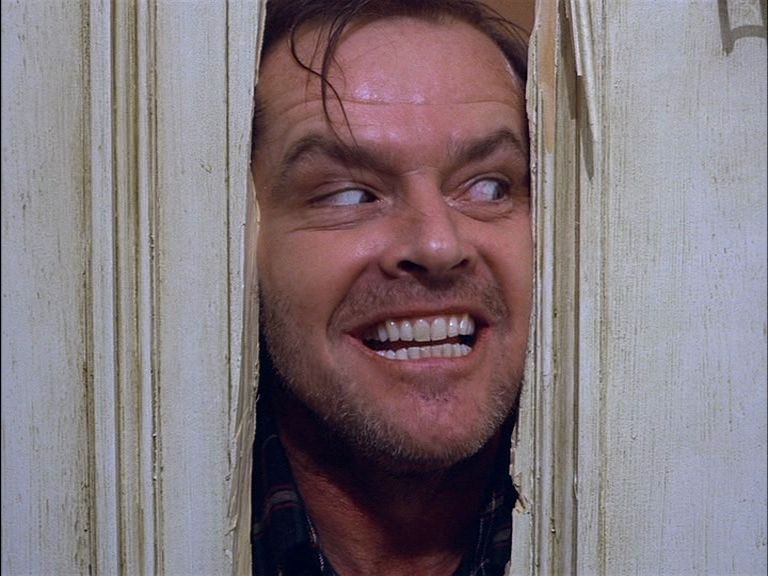
The famous "Here's Johnny!" sequence represents one of horror's most perfectly constructed climaxes, a scene that works on multiple levels simultaneously. Jack's axe attack becomes both literal threat and symbolic annihilation of the family unit, while Nicholson's channeling of Johnny Carson's catchphrase transforms American pop culture into instrument of terror.
The film's pacing demonstrates Kubrick's confidence in building dread through accumulation rather than constant stimulation. The first act establishes the hotel's vastness and isolation with almost documentary precision, allowing unease to build through careful observation rather than obvious horror beats. This patience makes the eventual eruptions of violence more shocking and effective.
The hedge maze serves as perfect metaphor for the film itself—a structure of elegant design concealing mortal danger, where getting lost means death, and escape requires either luck or supernatural intervention. The aerial shots of the maze, with tiny figures navigating its corridors, suggest forces at play beyond human comprehension or control.
Kubrick's direction maintains absolute control throughout, every element serving his vision of horror as something cold, precise, and inevitable. The film's famous perfectionism—hundreds of takes, destroyed careers, psychological warfare on set—becomes part of its legend, suggesting that creating art about madness may require a touch of madness itself.
The film's ending, with its revelation of Jack in a 1921 photograph, provides one of cinema's most ambiguous and discussed conclusions. Whether interpreted as reincarnation, time loop, or the hotel absorbing Jack into its eternal cycle of violence, the image suggests that what we've witnessed isn't conclusion but continuation, that the patterns of abuse and violence will perpetuate indefinitely.
The Shining's themes of domestic violence, alcoholism, and intergenerational trauma feel more relevant than ever, the film's horror deriving as much from recognizable family dysfunction as supernatural manifestation. Kubrick understands that the most effective horror often comes from the most familiar sources—the father who loses control, the family isolated from help, the cycle of violence that repeats across generations.
The technical execution remains flawless four decades later, with practical effects, locations, and cinematography that surpass most contemporary productions. The blood elevator, the murdered twins, the woman in Room 237—these images achieved through practical means feel more disturbing and real than any CGI could replicate.
The film's influence on subsequent horror and cinema in general cannot be overstated. Countless films have tried to replicate its aesthetic or recapture its atmosphere, yet none have matched Kubrick's particular combination of formal perfection and genuine psychological insight.
The Shining stands as the ultimate argument for horror as serious art, proof that genre filmmaking at its highest level can achieve everything that "prestige" cinema accomplishes while also delivering visceral impact that more respectable films cannot match. Kubrick created a masterpiece that functions simultaneously as terrifying horror experience, complex character study, historical meditation, and formal experiment—a work so rich and multifaceted that it continues revealing new dimensions with each viewing.
In a genre where mastery is measured by the ability to frighten, Kubrick created something that goes beyond fear to achieve genuine awe. The Shining doesn't simply scare—it overwhelms, consuming viewers in its precise, beautiful nightmare until the boundaries between what's real and what's imagined, what's supernatural and what's psychological, dissolve completely. This is horror filmmaking as pure cinema, a work that proves the genre's capacity for genuine artistic achievement while never forgetting its primary obligation to terrify absolutely.