Directed by Apichatpong Weerasethakul
7/10
1/10
3/10
8/10
9.5/10
9.5/10
Death as Gentle Visitor: Horror Without Fear in the Liminal Spaces
Apichatpong Weerasethakul's Uncle Boonmee Who Can Recall His Past Lives occupies a unique position in the Anatomy of a Scream catalog—a film that deals intimately with death, ghosts, and the supernatural yet approaches these traditionally horrific elements with such profound gentleness that it creates an entirely new category of experience. This is horror cinema's most radical experiment: what happens when we remove fear from the equation and examine death, memory, and the supernatural through the lens of acceptance rather than terror?
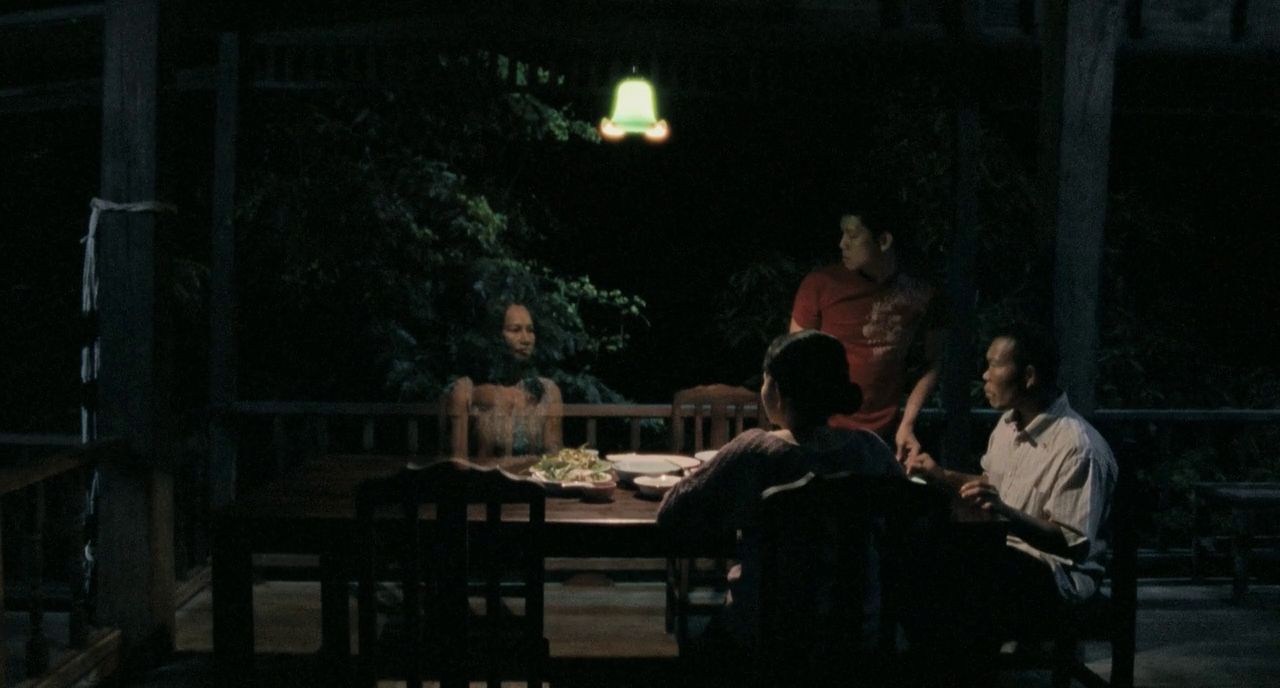
The film follows Boonmee, a middle-aged man dying of kidney failure, as he spends his final days at his family's farm in rural Thailand. What transforms this simple premise into something approaching the supernatural is Weerasethakul's matter-of-fact treatment of the impossible: the return of Boonmee's deceased wife Huay as a benevolent ghost, and his long-lost son Boonsong, who appears transformed into a red-eyed creature covered in dark fur. These manifestations are presented not as horrific intrusions but as natural extensions of the film's meditative exploration of life, death, and rebirth.
Thanapat Saisaymar's performance as Boonmee anchors the film with remarkable stillness and acceptance. His portrayal avoids both sentimentality and melodrama, instead creating a character who faces his approaching death with Buddhist equanimity. Saisaymar's Boonmee doesn't rage against the dying of the light—he observes it with curiosity and grace, making his supernatural encounters feel like logical extensions of a consciousness preparing to transition between states of being.
The film's visual language represents one of contemporary cinema's most extraordinary achievements in creating beauty from the mundane. Cinematographer Sayombhu Mukdeeprom transforms the Thai countryside into something that feels simultaneously documentary-real and dreamlike, where the boundaries between the natural and supernatural become permeable. The famous cave sequence, where characters venture into a limestone cavern that serves as both literal location and metaphysical space, creates images that feel like accessing collective unconscious memories of birth and death.
Weerasethakul's direction demonstrates unprecedented confidence in allowing narrative space for contemplation and mystery. Scenes unfold at the pace of natural conversation and organic revelation, with the filmmaker trusting audiences to engage with material that operates according to dream logic rather than conventional storytelling. The film's structure mirrors the Buddhist concept of reincarnation—circular rather than linear, with past and present lives bleeding into each other without clear demarcation.
The sound design creates an auditory landscape that feels alive with invisible presence. The constant buzz of insects, the rustling of vegetation, and the subtle electronic interventions create a world where the supernatural feels like part of the natural order rather than an intrusion upon it. The film's minimal score allows the ambient sounds of rural Thailand to become musical, creating rhythm and texture that supports the meditative pace.
The film's approach to its supernatural elements completely subverts horror conventions while remaining genuinely unsettling in its implications. The ghost of Huay appears as a caring presence, helping with household tasks and providing comfort during Boonmee's illness. His son's transformation into a creature is presented not as monstrous corruption but as another form of existence, equally valid and deserving of love. This radical reimagining of the supernatural suggests that our fear of death and the unknown may be culturally constructed rather than inherently necessary.
Uncle Boonmee's treatment of memory and time demonstrates sophisticated understanding of how consciousness relates to mortality. The film suggests that death is not ending but transformation, that the boundaries between past and present lives are artificial constructs that dissolve when approached with proper understanding. Boonmee's ability to recall his past incarnations doesn't function as supernatural ability but as natural human capacity that most people simply don't access.
The film's exploration of Buddhist philosophy never feels didactic or heavy-handed, instead emerging organically from the characters' experiences and the rhythms of rural life. The concept of karma is presented not as moral accounting but as natural law, like gravity or photosynthesis—simply part of how existence operates. This approach makes the film's metaphysical elements feel grounded in lived experience rather than abstract spirituality.
The production design creates a world that feels authentically Thai while remaining accessible to international audiences. The farm setting becomes a space where different temporal and spiritual realities can coexist naturally, while the costume and makeup work for the supernatural characters achieves the remarkable feat of making the impossible seem ordinary and unthreatening.
The film's famous monkey ghost sequence represents one of cinema's most unique supernatural encounters, presenting a sexual relationship between a woman and a catfish spirit with such matter-of-fact acceptance that it becomes oddly moving rather than disturbing. This sequence demonstrates Weerasethakul's ability to present taboo material without exploitation or sensationalism, treating all forms of connection and desire as equally valid expressions of life force.
Uncle Boonmee's pacing will challenge viewers accustomed to conventional narrative rhythms, but those willing to surrender to its meditative flow will find themselves rewarded with an experience unlike anything else in cinema. The film operates more like meditation or prayer than traditional entertainment, requiring active participation and openness to non-Western approaches to storytelling and spirituality.
The technical execution throughout demonstrates that art cinema can achieve profound emotional impact through careful attention to craft rather than spectacular effects. Every element—cinematography, sound design, editing, production design—serves the film's central vision of death as natural transition rather than terrifying ending.
The film's themes of mortality, memory, and spiritual transformation feel urgently relevant in an era when Western culture often struggles to develop healthy relationships with aging and death. Weerasethakul offers an alternative model for approaching these universal experiences, suggesting that acceptance and curiosity might be more useful responses than fear and denial.
Uncle Boonmee earns its place in the Anatomy of a Scream catalog not because it frightens in traditional ways, but because it fundamentally challenges how we think about death, the supernatural, and the boundaries of human experience. It represents horror cinema's capacity for radical experimentation, demonstrating that the genre's core concerns—mortality, the unknown, the limits of human understanding—can be explored through approaches other than fear and shock.
This is a film that doesn't simply entertain—it offers genuine wisdom about how to approach the most fundamental human experiences with grace and acceptance. In a genre often focused on death as enemy to be fought, Weerasethakul presents death as teacher and guide, creating something genuinely transformative for viewers willing to engage with its unconventional rhythms and profound humanity. Uncle Boonmee proves that horror's greatest achievement may not be making us afraid, but helping us become less afraid by expanding our understanding of what it means to be human in a universe far stranger and more generous than we typically imagine.