10/10
5/10
7/10
10/10
10/10
10/10
The Susuki Grass Inferno: Survival Horror as Primal Poetry
Kaneto Shindō's Onibaba stands as one of cinema's most ferocious achievements, a film that fuses folk horror, psychological terror, and sexual desperation into something that feels less like a movie and more like being trapped inside a fever dream conjured by ancient Japanese demons. This 1964 masterpiece doesn't simply tell a story about survival in wartime—it strips human behavior down to its most primal elements, revealing the beast that emerges when civilization collapses and only hunger, lust, and the will to survive remain. Six decades after its creation, Onibaba retains its power to unsettle and disturb, a work of such raw, elemental force that it seems to bypass rational thought and speak directly to our most primitive fears.
Set during Japan's civil war period, the film follows two women—a mother-in-law and daughter-in-law—who survive by murdering lost samurai and selling their armor and weapons. Their brutal routine is disrupted when a neighbor named Hachi returns from war, bringing news of the younger woman's husband's death and introducing sexual tension that threatens to destroy the older woman's hold over her companion. What unfolds is a psychological and supernatural nightmare where jealousy, desire, and desperation transform human beings into something monstrous.
Nobuko Otowa as the older woman delivers one of horror cinema's most powerful performances, creating a character whose desperation and rage feel so visceral they become almost unbearable to witness. Otowa inhabits the role with complete physical and emotional commitment, her body becoming an instrument of both labor and desire, her face a mask that occasionally cracks to reveal the terror beneath. Watch how she moves through the susuki grass with predatory efficiency during the murder sequences, then see how that same body becomes pathetic and pleading when confronting her sexual obsolescence.
Jitsuko Yoshimura as the younger woman provides the perfect counterbalance—youth and desire incarnate, a character whose sexual awakening becomes an act of rebellion against both social convention and the older woman's control. Yoshimura's performance captures the particular cruelty of youth discovering its own power, the way desire can make us willing to betray those who depend on us. The chemistry between these two performers creates a psychological battlefield where every interaction crackles with tension.
Shindō's visual language ranks among cinema's greatest achievements in creating atmosphere through pure imagery. Cinematographer Kiyomi Kuroda transforms the susuki grass fields into a kind of purgatory—an endless sea of vegetation that conceals predators and prey alike, where the boundaries between human and animal dissolve. The grass becomes both shelter and prison, providing cover for murder while trapping the women in their subsistence existence. The way Shindō photographs the grass—sometimes beautiful, sometimes suffocating, always oppressive—creates a visual environment that becomes as much antagonist as setting.
The film's use of high-contrast black-and-white photography creates images that feel carved from shadow and light rather than simply captured. The night scenes, which comprise much of the film, achieve a quality of darkness that feels absolute and primordial. When characters move through this darkness with torches, the effect is both beautiful and terrifying, suggesting medieval paintings of hell brought to cinematic life.
Hikaru Hayashi's percussion-driven score deserves recognition as one of horror's most viscerally effective musical achievements. Rather than traditional orchestral horror, Hayashi creates soundscapes built from drums, traditional Japanese instruments, and primal rhythms that feel like they're summoning something ancient and dangerous. The music doesn't simply accompany the action—it becomes part of the film's fabric, driving the narrative forward with relentless, hypnotic intensity.
The sound design creates an auditory landscape that feels alive with threat. The constant rustling of the susuki grass, the wind that never stops blowing, the distant sounds of warfare—these elements combine to create an environment where peace is impossible and danger is omnipresent. The contrast between the natural sounds and the sudden violence of the murder sequences creates a rhythm of tension and release that keeps audiences in a state of perpetual unease.
Onibaba's treatment of sexuality is remarkably frank and sophisticated for 1964, exploring how desire becomes another survival mechanism in extreme circumstances. The sexual relationship between the younger woman and Hachi isn't romanticized; it's portrayed as urgent, animalistic, and transactional. The film understands that in situations of extreme deprivation, sex becomes mixed with power, escape, and the simple human need for warmth and connection.
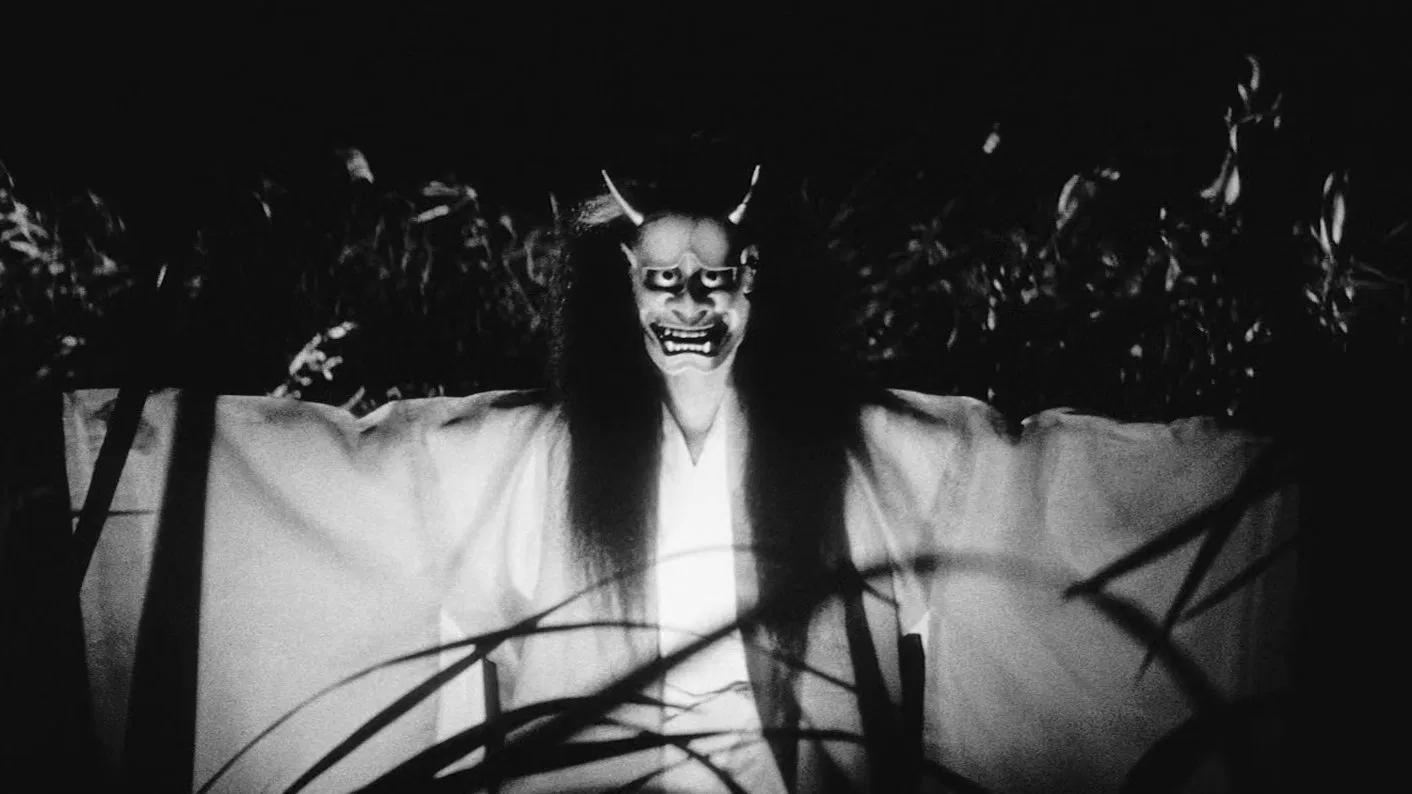
The older woman's jealousy and sexual frustration drive the film's horror elements, as her desperation to maintain control leads her to exploit a demon mask to terrify her companion. The mask sequence represents one of horror cinema's most perfect marriages of psychological and supernatural terror. The demon mask itself—with its grotesque features and fixed expression—becomes a literalization of the older woman's inner transformation, her jealousy and rage making her monstrous even before she dons the mask.
Shindō's direction maintains perfect control throughout, never allowing the film's extreme elements to tip into exploitation or camp. He treats the women's violence, sexuality, and desperation with complete seriousness, understanding that effective horror requires commitment to emotional truth rather than simple sensation. The murder sequences are brutal but never gratuitous, each killing feeling like a necessary act of survival rather than mere spectacle.
The film's exploration of Buddhist themes—particularly karma and the consequences of violence—adds philosophical depth without becoming didactic. The pit where the women dispose of bodies becomes a literal representation of hell, while the demon mask serves as instrument of divine punishment for the older woman's manipulation and cruelty. Shindō weaves these religious elements into the narrative organically, making them feel like natural extensions of the story rather than imposed symbolism.
The production design creates a world that feels both historically grounded and nightmarishly surreal. The women's hut, constructed from susuki grass and barely protecting them from the elements, suggests the thinness of the barrier between civilization and wilderness. The contrast between this crude shelter and the elaborate armor of the samurai they kill emphasizes the class divisions that make their survival necessary.
The film's climax, where the mask becomes literally fused to the older woman's face, represents one of horror's most devastating revelations. The sequence where she begs to have the mask removed, revealing her disfigured face beneath, achieves a kind of tragic horror that transcends simple fear. We witness the physical manifestation of how jealousy and cruelty destroy the person who harbors them, how attempting to become monstrous to control others results in actual transformation into something inhuman.
Onibaba's final images—the older woman's disfigured face, her desperate pleas, the younger woman's horrified recognition that she's looking at her own possible future—provide an ending that offers no comfort or redemption. The film suggests that survival in such extreme circumstances requires becoming something less than human, and that this transformation may be irreversible.
The themes of wartime survival, sexual desperation, and the dissolution of social order feel urgently contemporary despite the historical setting. Shindō has created a work that uses period horror to explore timeless questions about what humans become when stripped of civilizing structures and forced into pure survival mode.
Onibaba's influence on subsequent horror cinema cannot be overstated—its combination of folk horror, psychological terror, and sexual frankness established templates that filmmakers continue to explore. Yet no subsequent film has matched its particular combination of savage beauty and primal fear.
The technical execution remains stunning six decades later, with practical effects, locations, and cinematography that feel more convincing than many contemporary productions. The film's commitment to shooting in actual susuki grass fields under difficult conditions gives it an authenticity that studio work could never achieve.
Onibaba stands as proof that horror cinema's greatest achievements often come from filmmakers willing to push the genre into genuinely uncomfortable territory. Shindō has created a masterpiece that doesn't simply frighten—it strips away pretense to reveal the savage truth about human nature under pressure. It's a film that honors both horror's capacity for visceral impact and cinema's potential for profound artistic expression, a work that proves the two are not just compatible but can elevate each other to create something transcendent and terrible in equal measure.