9/10
7/10
9/10
9/10
10/10
10/10
The Mount Everest of Horror: Confronting Absolute Evil
William Friedkin's The Exorcist doesn't simply occupy the throne of horror cinema—it transcends the genre entirely to become something approaching religious experience, a work so powerful and uncompromising that it fundamentally altered what audiences expected from film itself. This is horror as high art, a movie that uses every tool of cinematic craft to create not just scares but genuine spiritual terror, forcing viewers to confront questions about faith, evil, and the nature of existence that most entertainment carefully avoids. Five decades after its release, The Exorcist remains the undisputed masterpiece of supernatural horror, a film that proves the genre's capacity to achieve genuine artistic greatness while delivering visceral impact that has never been equaled.
The film's genius lies in Friedkin's understanding that true horror emerges not from monsters jumping out of shadows, but from watching recognizable human beings—a loving mother, a devoted priest, an innocent child—confront forces that dwarf human understanding and threaten everything they hold sacred. The possession of Regan MacNeil becomes a vehicle for exploring the most fundamental questions of human existence: Does God exist? If so, why does He permit suffering? What happens when evil isn't metaphorical but literal and present?
Ellen Burstyn delivers what may be the greatest performance in horror cinema as Chris MacNeil, a mother watching her daughter disappear into something unrecognizable and malevolent. Burstyn's portrayal captures every stage of a parent's worst nightmare—the initial concern, the growing desperation, the willingness to consider increasingly unthinkable explanations, and finally the complete surrender of rational worldview in favor of anything that might save her child. Her performance anchors the film's emotional reality, making the supernatural elements feel not like fantasy but like the only possible explanation for unbearable circumstances.
Linda Blair's dual performance as Regan and the demon possessing her represents one of cinema's most challenging and successful child performances. Blair navigates the impossible task of portraying both innocent victim and incarnate evil, often within the same scene. Her work during the possession sequences—aided by Mercedes Ruehl's vocal performance as the demon—creates something genuinely disturbing, a presence that feels authentically inhuman while remaining recognizably the child we met in the film's opening act.
Jason Miller as Father Karras provides the film's spiritual and intellectual center, a priest whose crisis of faith makes him both the perfect victim for demonic manipulation and the ideal vehicle for exploring the film's theological themes. Miller's portrayal of doubt disguised as certainty, faith struggling with intellectual honesty, creates a character whose internal conflict mirrors the audience's own struggle to process what they're witnessing.
Max von Sydow as Father Merrin embodies the film's ultimate statement about the confrontation between good and evil. Despite limited screen time, von Sydow creates an unforgettable presence—a man who has literally stared into the abyss and returned, scarred but unbroken, to fight again. His Merrin represents faith not as naive belief but as hard-won knowledge of spiritual realities that most people are fortunate enough never to encounter.
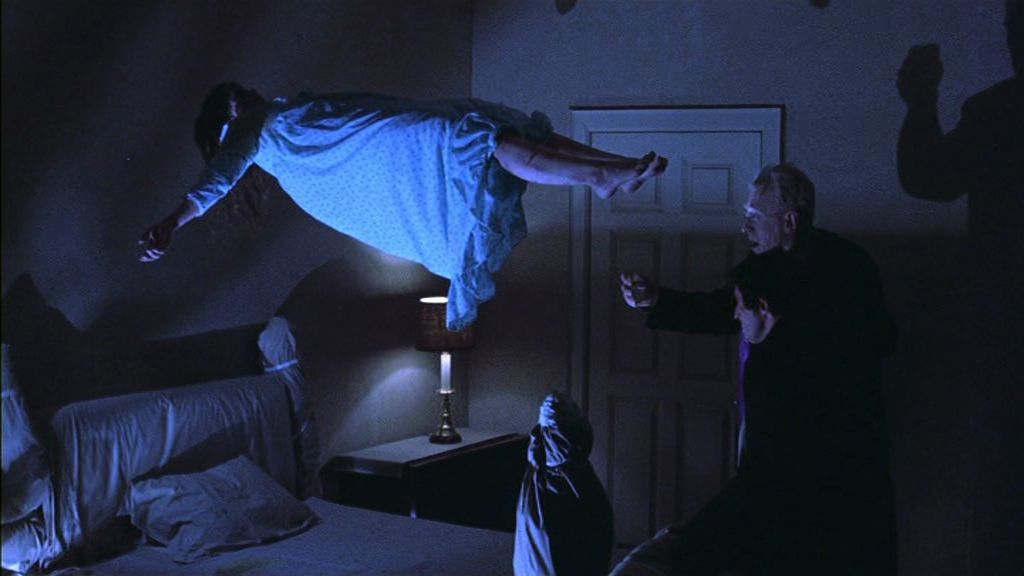
Friedkin's visual language achieves a perfect balance between naturalistic authenticity and expressionistic horror. Working with cinematographer Owen Roizman, he creates a world that feels completely real until the supernatural intrudes, at which point reality itself seems to buckle under the weight of otherworldly presence. The famous 360-degree head rotation, the levitation sequences, and the grotesque physical transformations feel shocking precisely because they occur within such carefully established realistic contexts.
The film's approach to its supernatural elements demonstrates sophisticated understanding of how special effects should serve emotional and thematic purposes rather than exist for their own sake. Every manifestation of demonic power—from the simple but terrifying voice changes to the elaborate physical contortions—serves to illustrate specific aspects of evil's assault on innocence, faith, and human dignity.
The sound design, overseen by Friedkin himself, represents one of cinema's most effective uses of audio to create psychological pressure. The subliminal sounds embedded throughout the film—recorded screams, animal noises, mechanical grinding—create an atmosphere of unease that operates below conscious awareness. Mike Oldfield's "Tubular Bells" becomes not just a theme but a character in its own right, its deceptively beautiful melody carrying undertones of profound menace.
The film's production design creates domestic spaces that feel both protective and vulnerable. The MacNeil house becomes a battleground between normal family life and supernatural invasion, with each room serving specific dramatic functions in the escalating conflict. The attic, in particular, becomes a space of liminal terror where the normal rules of physics and morality no longer apply.
The Exorcist's treatment of religious themes avoids both simple faith affirmation and cynical dismissal, instead presenting a complex meditation on belief in an age of scientific rationalism. The film suggests that faith isn't the absence of doubt but the willingness to act despite uncertainty, that courage isn't fearlessness but choosing to do what's right while terrified.
The medical sequences early in the film demonstrate Friedkin's commitment to exploring every rational explanation before embracing supernatural ones. The hospital scenes, with their invasive procedures and clinical terminology, create their own form of horror while establishing that conventional medicine has reached its limits. This approach makes the eventual turn to exorcism feel not like abandonment of reason but like the only remaining rational response to irrational circumstances.
The film's exploration of maternal love under extreme duress provides its emotional foundation. Chris MacNeil's journey from successful actress to desperate mother willing to embrace any belief system that might save her daughter creates a character arc that feels both universally recognizable and specific to the film's supernatural circumstances.
Friedkin's direction maintains perfect control throughout, never allowing the film's extreme elements to tip into exploitation or camp. He treats every moment—from quiet character development to shocking supernatural manifestations—with equal seriousness and attention to craft. The result is a film that feels completely unified in its vision and commitment to its themes.
The famous exorcism sequence represents one of cinema's most sustained and effective climaxes, a battle between good and evil that feels both spiritually authentic and dramatically satisfying. The interplay between the two priests, each contributing different strengths to the confrontation, creates a finale that honors both intellectual and intuitive approaches to faith.
The film's ending, with its suggestion of sacrifice and redemption, provides resolution without easy comfort. The victory over evil comes at enormous cost, suggesting that some battles, while winnable, leave permanent scars on those who fight them.
The Exorcist's technical execution remains flawless five decades later, with practical effects that feel more convincing than most contemporary CGI spectacles. The film's commitment to in-camera effects and authentic locations creates a tactile reality that makes the supernatural elements feel genuinely present rather than digitally imposed.
The film's cultural impact extends far beyond horror cinema, influencing discussions about faith, family, and the nature of evil in ways that continue to resonate. Friedkin created a work that functions simultaneously as entertainment, art, and spiritual meditation, proving that popular cinema can address the most profound questions of human existence without sacrificing accessibility or emotional impact.
The Exorcist stands as the absolute pinnacle of horror cinema, a work that demonstrates the genre's capacity to achieve genuine greatness while fulfilling its fundamental obligation to terrify. It's a film that doesn't simply frighten—it transforms, creating an experience so powerful and complete that it becomes part of the viewer's psychological landscape. In a genre too often dismissed as exploitation or escapism, Friedkin created something genuinely transcendent, a masterpiece that honors both the power of faith and the reality of evil while proving that horror, at its finest, can achieve the same artistic heights as any other form of cinema.