Directed by Roman Polanski
10/10
3/10
4/10
10/10
10/10
10/10
The Devil's in the Details: A Masterclass in Creeping Dread
Roman Polanski's Rosemary's Baby doesn't announce its horror with fanfare—it whispers it through cracked apartment walls, delivers it with concerned smiles from elderly neighbors, and births it through the mounting paranoia of a young woman whose own body becomes enemy territory. This is horror at its most insidious and sophisticated, a film that understands the genre's greatest power lies not in what it shows, but in what it makes you feel crawling beneath your skin long after the credits roll.
At its surface, Rosemary's Baby presents the archetypal nightmare of violated motherhood, but Polanski's genius lies in how he transforms Ira Levin's pulp novel into a suffocating meditation on female autonomy, urban isolation, and the banality of evil. The film operates as both supernatural thriller and searingly realistic portrait of a woman's agency being systematically stripped away by the very people who claim to protect her.
Mia Farrow's Rosemary Woodhouse is one of cinema's most perfectly crafted protagonists—not because she's heroic or particularly resourceful, but because she's heartbreakingly, recognizably human. Farrow's performance is a masterpiece of gradual deterioration, beginning with the bright-eyed optimism of a newlywed and slowly transforming into hollow-eyed desperation. Watch how her posture changes throughout the film, how her voice grows smaller, how her eyes become increasingly haunted. This isn't acting; it's psychological archaeology, each scene revealing another layer of a woman being systematically gaslit into questioning her own reality.
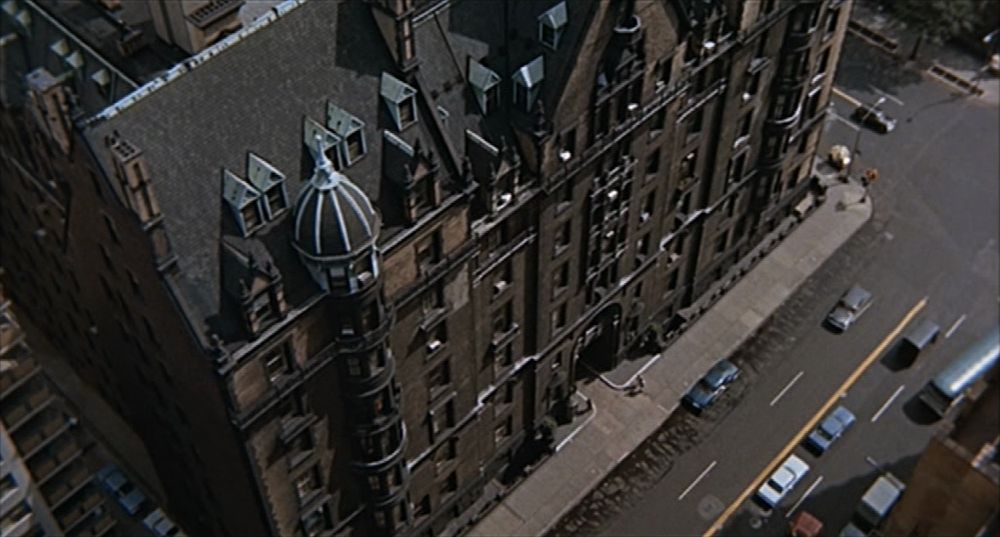
The film's visual language is deceptively simple yet profoundly unsettling. Polanski and cinematographer William A. Fraker create a world where every frame feels slightly off-kilter without ever resorting to obvious stylistic flourishes. The Bramford apartment, with its labyrinthine hallways and thin walls, becomes a character itself—a Gothic fortress disguised as urban domesticity. Notice how Polanski frequently frames Rosemary in doorways and through openings, creating compositions that suggest both protection and entrapment. The camera often lingers just a beat too long on seemingly innocent details: a pendant, a phone conversation overheard, the way light falls across an empty room. This visual restraint creates an atmosphere where normalcy itself becomes suspect.
The sound design deserves particular recognition for its subtlety. Krzysztof Komeda's lullaby-like score juxtaposes childlike innocence with underlying menace, while the ambient sounds of the Bramford—footsteps through walls, muffled conversations, the building's mechanical groans—create a sense of constant, invisible presence. The film understands that true horror often comes not from what we hear, but from what we strain to hear, the sounds that might or might not be there.
What elevates Rosemary's Baby beyond mere genre exercise is its unflinching examination of how evil operates in the real world. The Castevets aren't cackling villains—they're concerned neighbors who bring over meals and offer helpful advice. Guy Woodhouse isn't a monster—he's an ambitious actor who makes increasingly questionable compromises. Dr. Sapirstein isn't obviously sinister—he's a reassuring authority figure who speaks with medical certainty. The film's most chilling insight is that evil doesn't announce itself with thunder and lightning; it knocks politely on your door and asks if you need anything from the store.
This banality extends to the film's treatment of the supernatural elements. The devil worship isn't portrayed through elaborate rituals or gothic excess, but through apartment building dinner parties and casual conversations about herbs. The horror emerges from the gradual revelation that Rosemary's entire support system—husband, neighbors, doctors, friends—has been compromised, that the conspiracy against her is so total and so ordinary that resistance becomes almost impossible to imagine.
The film's themes resonate with particular power in its historical context, released at the height of 1960s social upheaval when traditional institutions were being questioned and challenged. Rosemary's experience can be read as an allegory for any number of systematic oppressions, but the film is careful never to reduce its horror to simple metaphor. The supernatural elements aren't symbolic window dressing; they're integral to the story's emotional logic, representing fears that feel psychologically real even when they defy rational explanation.
Polanski's direction maintains perfect control throughout, never allowing the film to tip into either camp or heavy-handed symbolism. He understands that effective horror requires precise calibration—too little and you lose the audience's investment, too much and you break the spell of believability. The famous rape scene, for example, is handled with remarkable restraint, conveying its horror through Rosemary's confused, drugged perspective rather than exploitative imagery. This approach makes the violation feel more real and therefore more disturbing than any graphic depiction could achieve.
The film's ending remains one of cinema's most perfectly ambiguous conclusions. Rosemary's final choice—to accept her role as mother to the Antichrist rather than abandon the child—can be read as either ultimate defeat or the assertion of a twisted kind of maternal agency. The ambiguity isn't frustrating; it's essential to the film's power, leaving audiences to grapple with questions that have no easy answers.
Rosemary's Baby endures because it understands that the most effective horror comes from recognizable human experiences pushed to their logical extremes. Every parent has felt moments of doubt about their fitness for the role; every woman has experienced the dismissal of her concerns by male authority figures; every urban dweller has wondered about the strangers living just beyond their walls. The film takes these universal anxieties and reveals the monsters that might be lurking within them.
Nearly six decades after its release, Rosemary's Baby remains a towering achievement in horror cinema, a film that proves the genre's capacity for serious artistic expression while never forgetting its primary obligation to disturb and unsettle. It's a masterpiece that honors both the intelligence of its audience and the dark power of perfectly crafted fear. In a genre too often content with easy shocks and surface-level thrills, Polanski's film stands as a reminder of what horror can achieve when it's wielded by a master craftsman who understands that the most effective monsters are the ones that live right next door.